
Polk County Superior Courts Overview
Georgia does not use District Court as the local trial-court label for Polk County. The primary trial court is Superior Court, and this page keeps the inherited district-court.html filename while using the correct local court name. Georgia's court structure places the Supreme Court of Georgia and Georgia Court of Appeals above trial-level courts. Trial-level courts include Superior Court, State Court where created, Juvenile Court, Probate Court, Magistrate Court, and Municipal Courts. Polk County's official judicial menu lists Superior, Magistrate, Probate, Juvenile, District Attorney, Public Defender, and related offices, but it did not show a separate Polk State Court page in the inspected sources.
Superior Court has broad civil and criminal jurisdiction. Georgia court materials describe Superior Court as handling felony trials, exclusive divorce jurisdiction, significant civil matters, and review or correction of errors from lower judicatories in some contexts. Polk's Superior Court page localizes that structure to Courthouse No. 1, where the Clerk of Superior Court, judges, public terminal access, jury information, e-filing links, GSCCCA tools, FANS, eCertification, Kofile, and motion-court calendar instructions are grouped for public users.
The primary records destination is the Clerk of Superior Court at 100 Prior Street, Suite 106, Cedartown, GA 30125. Motion Court is held every Tuesday and Wednesday at 9:00 a.m., and the JusticePath app carries motion-court calendars. Public search terminals are available during regular office hours, but the Clerk's office says it does not perform criminal searches or title searches for the public.
List of Polk County Superior Courts
Polk County does not have a numbered district-court roster. The local trial-court table is better understood as a courthouse and judge roster for the Superior Court and the related court offices that route records users to the right place. The Superior Court judges listed for Polk are Chief Judge Mark H. Murphy and Judge Andrew B. Roper, both serving in the Tallapoosa Judicial Circuit. The Clerk of Superior Court is Stacie M. Baines.
| Court / Office | Type | Address | Phone |
|---|---|---|---|
| Superior Court / Clerk of Superior Court | Trial court records | 100 Prior Street, Suite 106, Cedartown, GA 30125 | 770-749-2114 |
| Chief Judge Mark H. Murphy | Superior Court judge | 100 Prior Street, Suite 105, Cedartown, GA 30125 | Polk 770-749-2976; Haralson 770-646-2025 |
| Judge Andrew B. Roper | Superior Court judge | 100 Prior Street, Suite 103, Cedartown, GA 30125 | Polk 770-749-6790; Haralson 770-646-2018 |
| District Attorney | Superior and Juvenile prosecution | 100 Prior Street, Room 204, Cedartown, GA 30125 | 770-749-2106 |
| Public Defender | Criminal defense for qualifying defendants | 109 East Avenue, Cedartown, GA 30125 | 770-748-3480 |
The GSCCCA Polk County clerk profile source confirms Clerk Stacie M. Baines, the office address, hours, phone, and managed court functions.
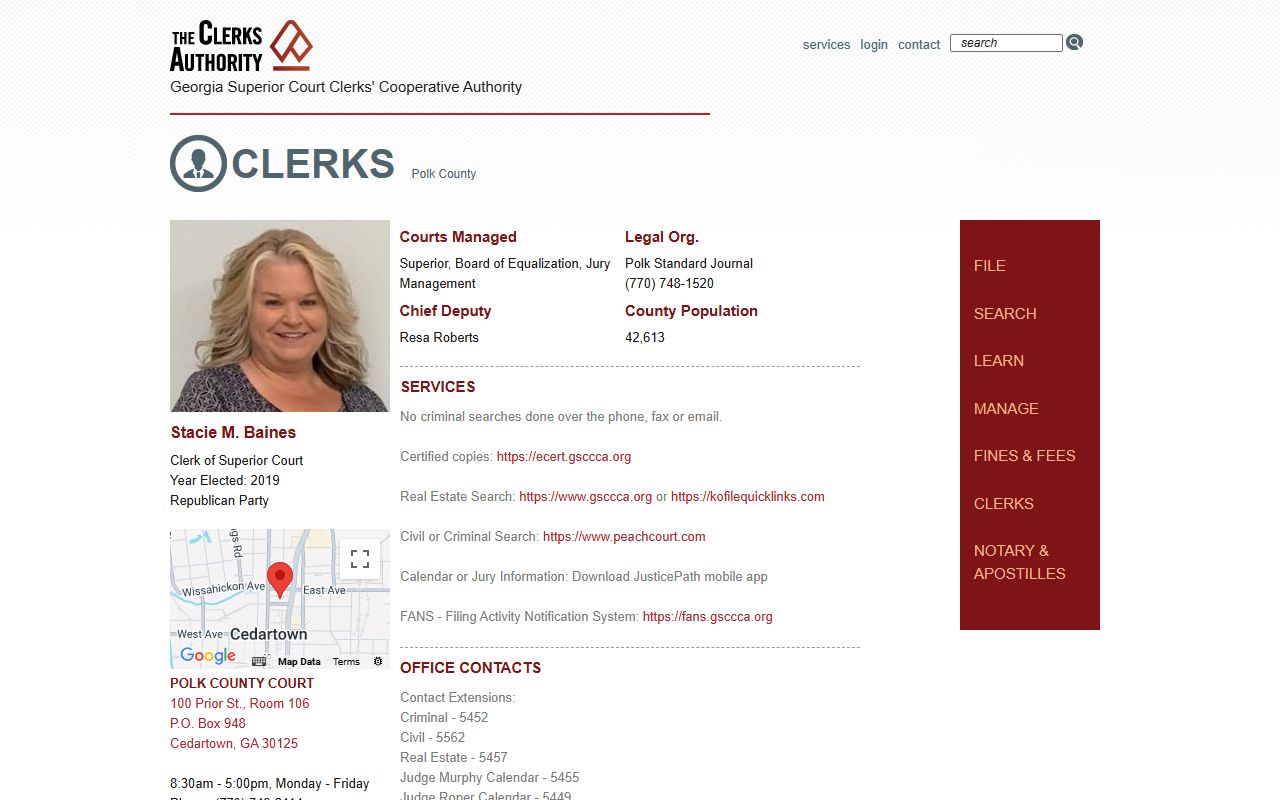
The clerk profile helps distinguish the Superior Court record office from Probate Court and Magistrate Court access points.
Superior Court vs. Probate Court vs. Magistrate Court
Polk County records users often need to decide whether a record belongs in Superior, Probate, Magistrate, Juvenile, or Municipal Court. Felonies and divorces point to Superior Court. Wills, estates, guardianships, marriage licenses, vital records, weapons carry, and misdemeanor traffic court point to Probate Court. Small civil claims, dispossessory actions, garnishments, ordinance violations, preliminary hearings, warrant applications, bail hearings, and bad-check matters point to Magistrate Court. Municipal courts may handle city traffic or ordinance citations.
| Superior Court | Probate Court | Magistrate Court | |
|---|---|---|---|
| Civil Limit | Broad civil jurisdiction and higher-level matters | Probate, guardianship, and related statutory matters | Polk civil claims up to $15,000 for defendants residing in Polk County |
| Criminal Jurisdiction | Felonies and serious criminal proceedings | Misdemeanor traffic court in local Polk practice | Preliminary hearings, warrant applications, bail hearings, ordinance and bad-check matters |
| Family Cases | Divorce and related Superior Court family filings | Marriage licenses and some guardianship matters | No divorce jurisdiction |
| Record Access | Clerk counter, public terminals, GSCCCA/eCertification, PeachCourt, Kofile, FANS | Probate counter, Georgia Probate Records, FeePayOnline, EZCourtPay for citations | Georgia Magistrate Public Records for participating civil, ordinance, and deposit-account fraud searches |
How a Case Moves Through the Polk County System
Criminal and civil matters do not all begin in Superior Court. A person arrested on a charge may first appear through Magistrate Court for bail or preliminary handling. Felony prosecution then moves through the District Attorney and Superior Court. Traffic matters may stay with Probate Court or a municipal court. Civil disputes below the Magistrate Court limit may begin in Magistrate Court, while divorce and major civil matters are Superior Court filings.
Criminal flow: Arrest › Magistrate or First Appearance › Indictment or Accusation › Arraignment › Motions › Trial or Plea › Sentencing › Appeal
Civil flow: Petition or Complaint Filed › Answer › Discovery › Motions › Mediation or Hearing › Trial › Judgment › Appeal
Jurors use the Superior Court jury information line, 770-749-2036. The local instructions tell jurors to call Sunday evening before their report date and, during trial weeks, after 6:00 p.m. each night for next-day instructions. Juror pay is $40 per day when reporting or serving, and audio aid equipment is available on request.
Civil, Family, and Criminal Divisions
Superior Court civil records may include contract disputes, tort claims, equity matters, land or title disputes, injunctions, judgments, and other higher-level civil filings. The clerk-linked electronic systems include PeachCourt for civil and criminal e-filing, GSCCCA eCertification for certified digital documents, Kofile Quicklinks for historic plats and deed indexes, and FANS for filing activity notifications. Public terminals are the local fallback when staff cannot perform a broad search for the public.
Family-related Superior Court records in Polk include divorces because Georgia places divorce jurisdiction in Superior Court. Divorce files may include pleadings, parenting plans, child-support worksheets, settlement papers, motions, orders, and a final decree, with some sensitive information sealed or restricted. Criminal Superior Court records may include felony charges, indictments or accusations, pleas, motions, sentencing, probation revocations, and related orders. The Tallapoosa Judicial Circuit District Attorney represents Georgia in Superior Court criminal matters, while the Public Defender represents qualifying defendants in covered criminal cases.
The JusticePath Android source is the mobile app path linked for motion-court calendar access.
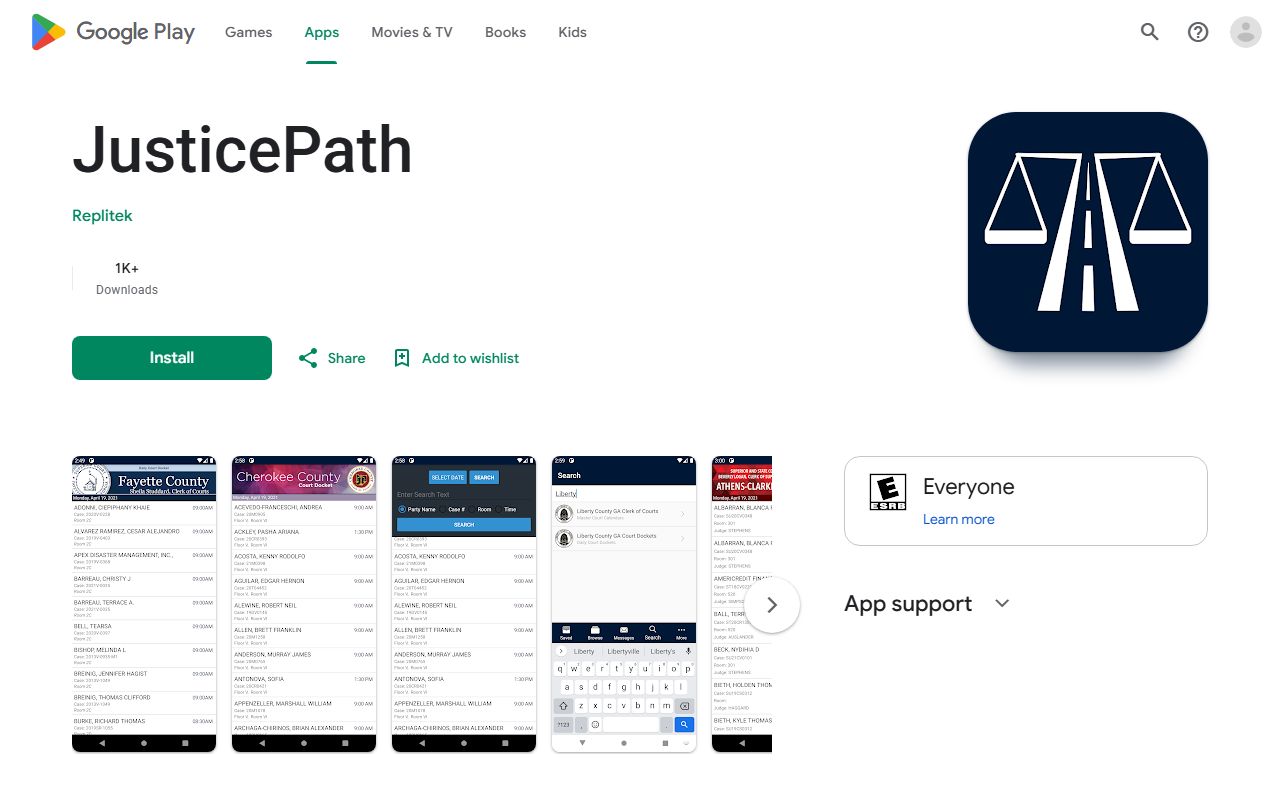
JusticePath is useful for calendar awareness, but record copies still route through the appropriate clerk or court office.
Judicial Circuit / District
Polk County is part of the Tallapoosa Judicial Circuit. The local Superior Court judge listings include Chief Judge Mark H. Murphy and Judge Andrew B. Roper. The District Attorney is Jaeson Smith, whose office is at Courthouse No. 1, Room 204. The DA page states that the office handles felony and a variety of misdemeanor cases, assists crime victims, and manages public resources responsibly. It also says the DA represents Georgia in criminal matters in Superior Court and Juvenile Court.
Federal court is separate from Polk County Superior Court. Polk County falls within the Northern District of Georgia for federal trial matters, with federal records handled through federal court systems rather than the county Clerk of Superior Court. For federal prosecutions, the U.S. Attorney's Office for the Northern District of Georgia is the relevant federal prosecuting office.
The U.S. Attorney's Office source is the federal prosecution reference for the Northern District of Georgia.
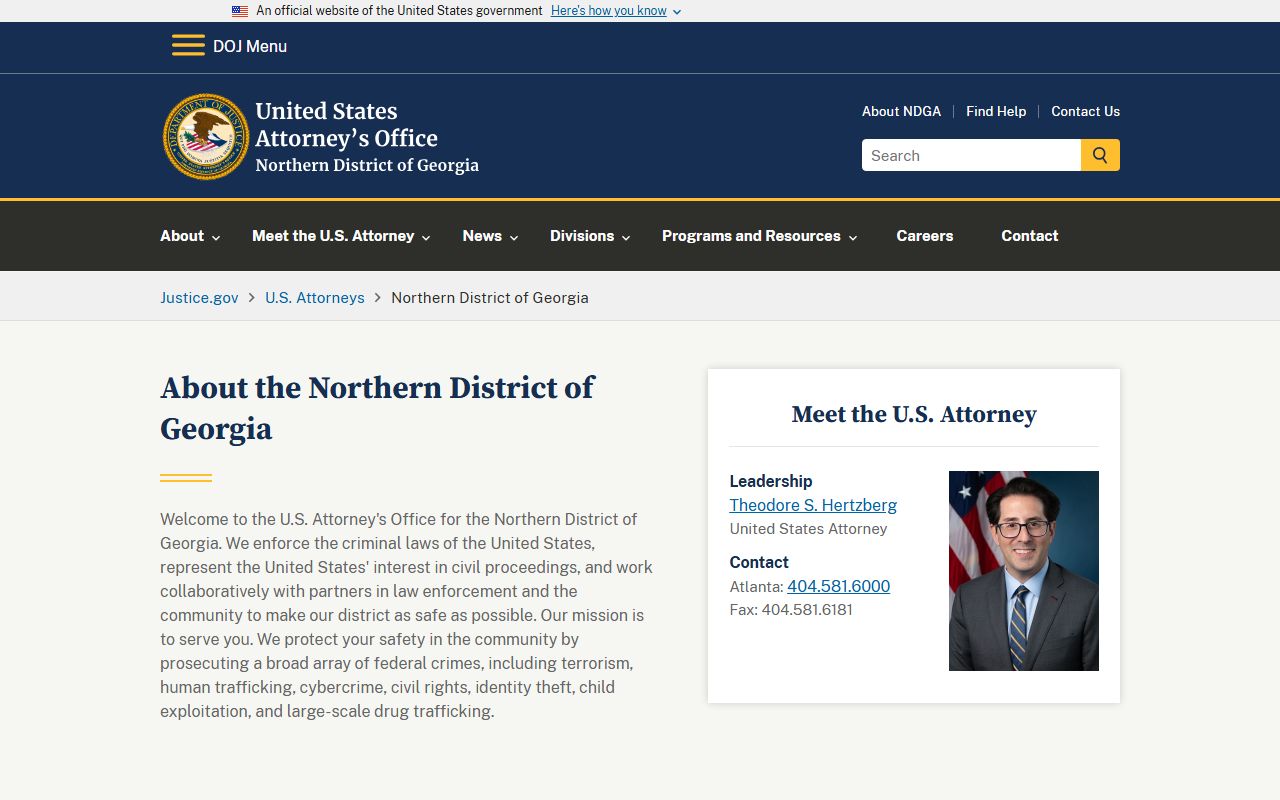
That federal source should not be confused with the local District Attorney or the Polk County Superior Court record file.
Magistrate and Lower Courts
Lower-court routing is part of an accurate Superior Court search. Polk Magistrate Court is at Courthouse No. 2, 102 Prior Street, Suite 203, Cedartown, with phone 770-749-2130 and clerk phone 770-749-2187. Magistrate Court handles civil claims up to $15,000, dispossessory actions, garnishments, preliminary hearings, arrest-warrant applications, bail hearings for non-capital offenses, county ordinance matters, animal-control violations, extradition hearings, and deposit-account fraud issues. Georgia Magistrate Public Records supports participating Polk searches for civil filings, ordinance violations, and deposit-account fraud.
Polk Probate Court is in Courthouse No. 1, Room 102, and handles wills, estates, guardianships, marriage, vital records, weapons carry, and misdemeanor traffic court. Juvenile Court has restricted child-focused records and requires original documents for filed packets. Municipal Courts may hold city traffic and ordinance matters for places such as Cedartown, Rockmart, or Aragon. Appeals or review can move upward under Georgia procedure, but the first practical step is identifying the issuing court named on the citation, warrant, docket notice, or filing receipt.
Superior Court users should also separate court records from law-enforcement and jail records. A jail roster charge can point to Superior Court, Probate Court, or a municipal court, but the roster does not show every motion, plea, order, or sentence. A District Attorney notice, Public Defender application, subpoena, jury summons, or JusticePath calendar entry may help identify the courtroom, yet certified copies and official case records still come through the clerk or the court that maintains the file.
For in-person access, confirm the right building before travel. Superior Court, the Clerk of Superior Court, Probate Court, and the District Attorney are at 100 Prior Street. Magistrate Court is at 102 Prior Street. The two buildings are close, but going to the wrong counter can slow a time-sensitive search for a motion setting, warrant-related hearing, certified order, or traffic file.